
Blog

Cyber resilience in 2026 looks very different from the past.
Enterprises no longer ask, “Did my backup run?”
They ask, “Can I recover clean, fast, and with confidence?”
Ransomware, supply-chain attacks, compliance pressure, and hybrid sprawl have turned recovery into a business-critical capability, not an IT checkbox. Organizations that still equate resilience with backup jobs are discovering – that recovery failures cost far more than downtime.
Read more to see how leading enterprises are shifting from backup to measurable recovery.
Modern resilience focuses on recoverability, not backup completion.
Leading organizations now measure:
Measurable impact:
Recovery fails most often due to unknown dependencies and outdated assets.
By unifying infrastructure, lifecycle status, and protection coverage, enterprises gain clarity before incidents occur.
Measurable impact:
In 2026, regulators and boards expect proof that recovered systems are:
Recovery without validation is risk, not resilience.
Measurable impact:
Assets near EOL/EOS introduce hidden recovery risk – unsupported OS, outdated firmware, un-patchable systems.
Lifecycle awareness ensures recovery plans don’t rely on fragile infrastructure.
Measurable impact:
Energy efficiency is no longer just a facilities concern – it’s a board-level IT metric.
Enterprises are optimizing energy usage by identifying underutilized systems, inefficient placements, and power-heavy legacy stacks.
Measurable outcomes:
Not all workloads deserve the same recovery path.
Enterprises now map:
This enables recovery sequencing that protects revenue and trust.
Measurable impact:
Cyber resilience breaks down when backup, infrastructure, security, and compliance teams operate in silos.
Unified intelligence replaces fragmented dashboards with one source of truth.
Measurable impact:
Enterprises are shifting from annual DR tests to continuous recovery readiness.
Automated validation exposes gaps before attackers do.
Measurable impact:
Regulations increasingly expect:
Resilience now supports compliance, not just uptime.
Measurable impact:
Boards want answers to:
Data-driven resilience turns fear into foresight.
Measurable impact:
Enterprises winning in 2026 treat cyber resilience as:
Platforms like ZENfra enable this shift by connecting asset lifecycle, protection coverage, recovery readiness, and risk visibility into one intelligent system – turning resilience from assumption into proof.
Read more to explore how measurable recovery changes everything.
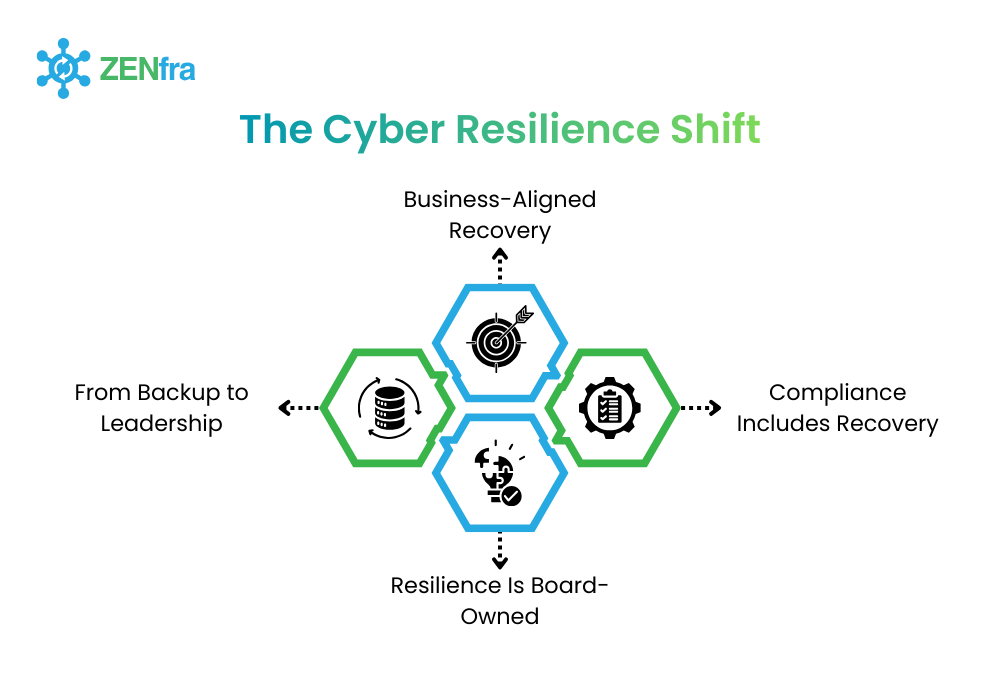
Backup alone won’t protect your business in 2026.
Recovery must be clean, provable, prioritized, and fast.
Organizations that invest in unified visibility, lifecycle intelligence, and recovery validation don’t just survive incidents – they recover with confidence.
Contact our experts to explore how leading enterprises are redefining cyber resilience with measurable outcomes – before the next incident tests them.
ZENfra’s AI-powered solutions can help you predict, secure, and streamline your cloud initiatives. Ready to take the lead? Let’s talk!
Experience a data platform specifically developed for wide-ranging data access, advanced analytics, and streamlined automation.
5000 Quorum Drive
| Suite 710 | Dallas, TX 75254