
Blog
For years, enterprises accepted infrastructure failures as a cost of doing business. Hardware was pushed to its limits, issues were addressed only after outages, and replacements happened under pressure. Today, that mindset is changing. With Predictive maintenance AIOps, AIOps infrastructure analytics, and the ability to Modernize your IT infrastructure, organizations are shifting from reactive firefighting to proactive lifecycle planning-without increasing operational complexity.
This shift isn’t about technology alone. It’s about protecting business continuity, budgets, and long-term transformation goals, all aligned with a structured asset lifecycle management approach.
Most IT leaders don’t see asset failure as a single event-it’s a chain reaction. Downtime disrupts users, emergency procurement inflates costs, and teams lose credibility with the business.
Common challenges enterprises face:
• Asset failures detected only after performance degrades
• Replacement decisions made without usage or risk context
• Maintenance budgets spent reactively instead of strategically
• Leadership forced into last-minute approvals under pressure
Without data-backed foresight, IT teams remain stuck reacting instead of planning.
The move to planned lifecycle management begins when systems start learning from behavior patterns instead of waiting for alerts. Predictive maintenance for IT infrastructure uses telemetry, performance trends, and anomaly detection to forecast when assets are approaching risk thresholds-long before service impact occurs.
This allows enterprises to:
• Schedule replacements during low-impact windows
• Extend asset life where performance remains stable
• Align refresh cycles with business roadmaps
• Eliminate emergency downtime scenarios
With technology asset management driving this transition, businesses move from the uncertainty of reactive decision-making to the clarity of predictive planning.
Planned replacement isn’t just about avoiding failure-it’s about progress. When insights guide timing, organizations can Modernize your IT infrastructure cost optimization in phases, avoiding large-scale disruptions while steadily improving performance, security, and scalability.
This phased approach enables:
• Controlled modernization aligned to growth initiatives
• Reduced technical debt without operational shock
• Smarter adoption of cloud and hybrid architectures
• Infrastructure that evolves with the business, not against it
By integrating predictive maintenance technology IT infrastructure, businesses modernize with strategic foresight and precision.
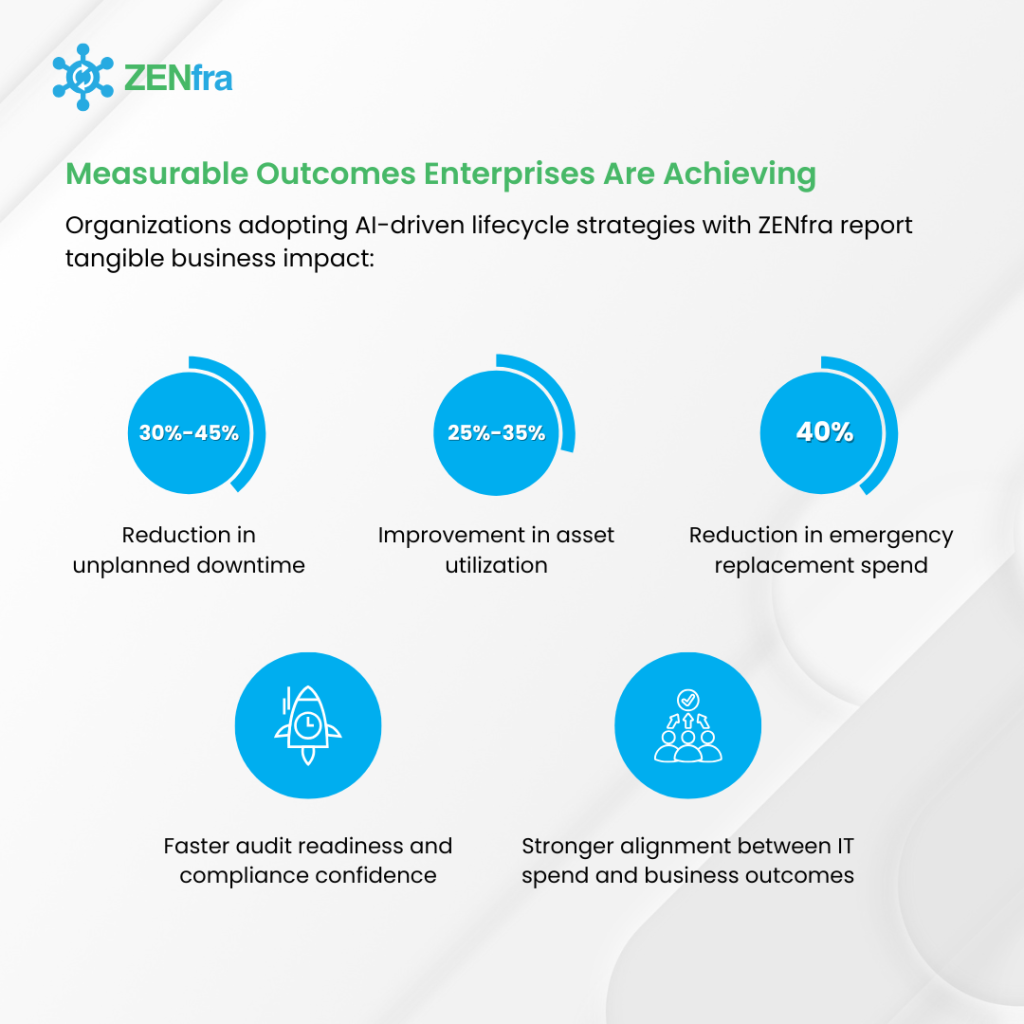
These outcomes are driven by the combined power of Predictive maintenance AIOps, AIOps infrastructure analytics, and a structured approach to Modernize your IT infrastructure-working together as one strategy.
ZENfra doesn’t just surface insights-it enables action. Our platform is built to help enterprises move from operational uncertainty to lifecycle confidence.
What sets ZENfra apart:
• AI models trained on real enterprise infrastructure patterns
• Business-context mapping, not just technical alerts
• Actionable recommendations tied to replacement planning
• Scalable analytics across hybrid and complex environments
Infrastructure asset management becomes more than just a system upgrade-it’s a strategic initiative that secures your future.
Infrastructure failure doesn’t have to dictate your roadmap. With the right intelligence, enterprises can anticipate risk, control spend, and modernize with confidence. The shift from “run to fail” to “plan to replace” isn’t just an operational improvement-it’s a competitive advantage.
ZENfra’s AI-powered solutions can help you predict, secure, and streamline your cloud initiatives. Ready to take the lead? Let’s talk!
Experience a data platform specifically developed for wide-ranging data access, advanced analytics, and streamlined automation.
5000 Quorum Drive
| Suite 710 | Dallas, TX 75254