
Blog
In 2026, optimization is no longer a reaction to budget cuts.
It’s a leadership decision.
Enterprises are under growing pressure to reduce costs, improve performance consistency, and meet energy and sustainability goals – all while avoiding new operational or security risks. Traditional optimization approaches often fail because they rely on assumptions, siloed tools, or disruptive changes.
Leading organizations are now shifting to data-driven optimization – delivering measurable gains without disruption.
Read to see how optimization leaders are doing it differently.
Optimization starts with knowing what’s actually happening across your infrastructure – not what dashboards assume.
Enterprises that establish clear visibility into utilization, growth trends, and configuration gaps eliminate guesswork and focus only on changes that matter.
Measurable outcomes:
For CIOs and program leaders, fragmented migration dashboards are a persistent challenge.
ZENmig unifies visibility into a single, intelligent workspace – aligning progress tracking, compliance, and performance metrics across teams and systems.
Executives gain a single source of truth for every workload, migration wave, and success metric – eliminating silos and ensuring faster, smarter decisions.
Key Advantage: One unified command center – governance, collaboration, and control.
In 2026, optimization isn’t about cutting resources – it’s about right-sizing them.
By aligning infrastructure capacity to real demand, enterprises reduce spend while maintaining – or improving – service reliability.
Measurable outcomes:
Performance issues often hide in plain sight – misaligned configurations, resource contention, and legacy constraints.
Modern optimization focuses on removing these frictions before adding capacity.
Measurable outcomes:
Faster application response times for priority service
Energy efficiency is no longer just a facilities concern – it’s a board-level IT metric.
Enterprises are optimizing energy usage by identifying underutilized systems, inefficient placements, and power-heavy legacy stacks.
Measurable outcomes:
Optimization that ignores asset lifecycle creates hidden risk.
By factoring in EOL/EOS timelines, supportability, and compatibility, enterprises avoid savings that later turn into outages or security gaps.
Measurable outcomes:
A major shift in 2026 is reclaiming value from existing assets instead of expanding blindly.
Enterprises are discovering idle compute, unused storage, and redundant licenses already on the books.
Measurable outcomes:
Not all workloads deserve equal optimization effort.
By aligning optimization decisions to business criticality, enterprises focus resources where they create the most value.
Measurable outcomes:
Manual optimization doesn’t scale in complex environments.
Automation enables continuous tuning, faster response to demand shifts, and consistent execution.
Measurable outcomes:
Optimization no longer needs to mean downtime or risky changes.
Enterprises now prioritize staged, low-risk improvements that protect customer experience.
Measurable outcomes:
Winning organizations treat optimization as an ongoing capability – not a one-time clean-up exercise.
They continuously measure, refine, and improve across cost, performance, energy, and risk.
Measurable outcomes:
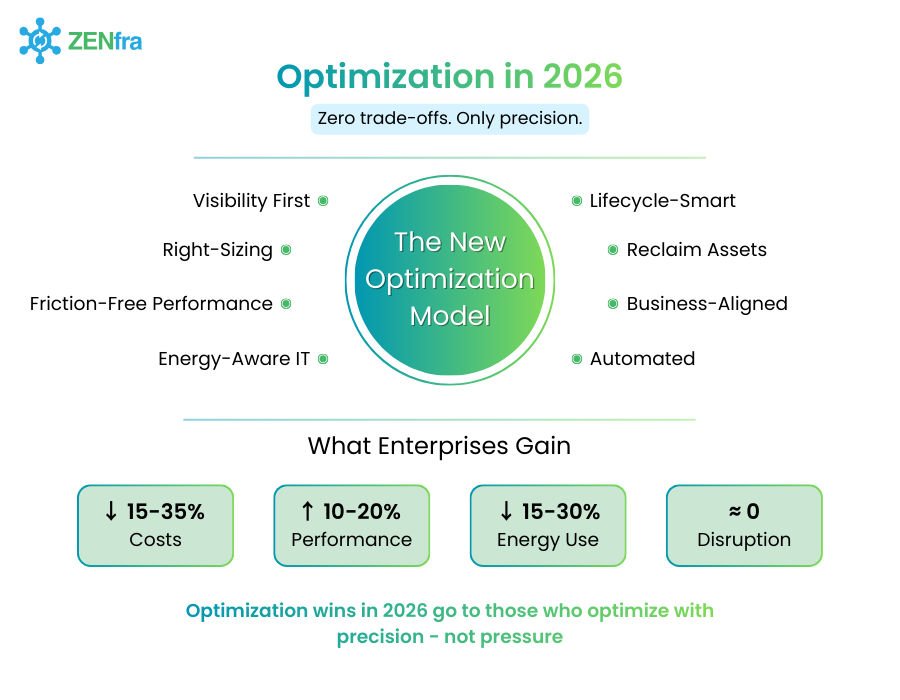
Optimization in 2026 is not about aggressive cuts or risky shortcuts.
It’s about precision – knowing where to act, when to act, and what not to touch.
Contact Us
Enterprises that embrace data-driven, lifecycle-aware optimization achieve:
ZENfra’s AI-powered solutions can help you predict, secure, and streamline your cloud initiatives. Ready to take the lead? Let’s talk!
Experience a data platform specifically developed for wide-ranging data access, advanced analytics, and streamlined automation.
5000 Quorum Drive
| Suite 710 | Dallas, TX 75254